
Glimmerings
A wonderful book of letters between Chris Wiman and Miroslav Volf

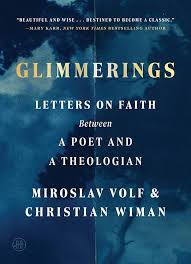
I have immensely enjoyed “Glimmerings: Letters on Faith Between a Poet and a Theologian.” The Poet is none other than Chris Wiman, the author of “My Bright Abyss,” the riveting and touching story of his conversion, or perhaps better, his recovery of his Christian faith. The theologian is Miroslav Volf, the theologian and author of numerous important books such a ”Exclusion and Embrace.” They both teach at Yale Divinity School and Volf and Wiman sometimes teach a very popular undergraduate course there called “Life Worth Living.”
This book is simply made up of letters exchanged between them over the course of a year in which both of them talk about their faith, its struggles and profundities. During that period of time, Wiman also went through a painful stem cell replacement therapy for the cancer that has dogged him for years, and has put pressure on his faith. In this intimate exchange the reader really gets to know these two extraordinary and unique men, and along the way, to inevitably confront one’s own struggles and questions.
There are many insightful portions of these letters, but I will quote one from each of the authors. First, from Volf, in one of the last letters he sums up his faith, what he calls his Credo, which I found wonderfully hopeful and beautiful, a statment of faith I I could readily adopt as my own.
I believe that love is God’s very being. If God were not love, God could both love and not love. But since God is love, God always loves. Whatever God does, God does out of love. Which is why God’s love is presuppositionless and unconditional. Since love is a relation, the One and indivisible God who is love exists as three divine persons, each both a self and an other, each both a subject and an object of love.
I believe that this God, the God who is love, creates everything that isn’t God. God creates out of love and for love. Creation is a gift. Each creature and all together in their interdependence are given to each for their good and their joy. As the gift of the God of love, creation itself is good. Even marked by futility and colonized by evil, creation is still in a primordial sense good—and loved by God just for existing.
I believe that God seeks to mend all broken creatures and liberate them from futility and the power of evil. That God was in Jesus Christ. Jesus Christ was that God when he taught and healed in the land of Israel and beyond and when he was crucified for being and doing good. God “died” for God’s beloved creatures even when they become God’s enemies, ungodly and unjust.
I believe that this God of love seeks to dwell in each human being and in the whole creation, not as an extraneous and, perhaps, intruding add-on, but as the source of fulfillment of each unique creature. The coming of God is itself a gift which we receive by opening ourselves to God in Christ. In this way, we come to grow in being “Christs” to one another and the world.
God’s kind of love, situation-independent and unconditional, is therefore the hallmark of the Christian life. Love of enemy, no less than love of neighbor, is essential to Christian life. As a life of love, Christian life is often marked by suffering. Love’s suffering is a means; Love’s dance is the goal. That goal is a world of love, a community of creatures rightly related to God and one another. This kind of world, fully itself by being indwelled by God, is our final end. Miroslav, your bedraggled fellow acolyte of Christ.
And then, in the next letter, there’s this response from Wiman, so tender and so vulnerable.
I love the idea of after-angels, those presences we become aware of only retrospectively. “Didn’t our hearts burn within us?” the disciples wonder on their way to Emmaus, after Jesus has revealed himself to them and vanished in the light of their understanding, which is just the plain old everyday light of life. And in fact I have my own recent retroactive angel, and you were there.
The other day when we were walking around the expensive spring-gleaming blocks north of the div school, and I was trying to tell you without really telling you why I was finding the essay I was writing on Seamus Heaney and American poetry so painful and destabilizing, you asked me, very gently (the tone changed), if I could explain why.
And rather than resort to “professional” deflections, as I would usually do, I found myself (that’s what it felt like, both surprising and revelatory: I found myself) speaking the truth. The essay had brought me face-to-face with my own work and life, the ambitions I had when I was young and the reality of my fifty-seven-year-old circumstances, and the clarity of the perception—I have fallen short—hurt.
I wasn’t sleeping well. I was picking up my own books and thumbing through them like essential instruction manuals in a language I couldn’t read. I was drowning in despair. Absurdly and preposterously, yes, as the water was about an inch deep. But to an infant—and suddenly that’s what I seemed to be—even a puddle can prove fatal.
We stopped on the street. And rather than offer consolation or disputing my assessment of the situation, you simply admitted to sometimes feeling the same thing. And suddenly I felt—I don’t know—released. The feeling wasn’t gone. The recriminations still seethed and roiled in my soul like those little blurps of air in cooking oatmeal. I still felt the cold undertow of oblivion. But I also felt lightened, alive in the spring-gleaming streets, myself and glad for that.
Why? Nothing had changed. I can only think that the act of two bare, forked creatures acknowledging their bare, forked creatureliness enabled Christ to come among them, in them and between them. I carried the moment with me for days. I carry it now.
(And, of course, there’s this: The despair was not really for my work but for my soul. It was an expression of distance from God, a confusion to which I am apparently still prone. Poetry has its place and powers but only so long as that place and those powers remain relative to God.)
I am a Christian because of moments like that one. I am a Christian because, when I live toward God, when I allow myself (or am allowed) to inhabit a reality whose very realness depends upon God, I feel . . . right. I feel like my life and mind align with the stars and the trees, and I am both utterly myself and freed from that. It’s the oldest lesson in Christianity, no? St. Paul hammers it home again and again. A certain submission to one’s insignificance is the only chance of freedom. The paradox is that the “insignificance” is illusory. In God’s reality—which is, simply, reality—that bare, forked creature blazes with a radiance that no lesser reality—the failures of ambition, the achievements of ambition—can touch.
You will find these glimmerings of faith and doubt, these intimate struggles of faith we all experiece all through the book. I recommend it highly.
Thanks for this recommendation, Len!
I agree! Transcendent is a good word. I wrote about Glimmerings, too. https://substack.com/@mavismoon/note/p-187685730?r=1vkdm&utm_medium=ios&utm_source=notes-share-action