
Should the Lord's Table be Open to All?
Closed, Close, or Y'all Come?

Growing up in the Christian Reformed Church, Holy Communion was a very special event. It was normally celebrated 4 to 6 times a year, and those Sundays were special indeed. You saw it and felt it throughout the service.
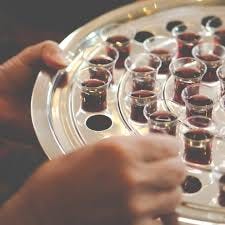
The church was crowded, no one who was at all able to attend was absent. Then, you could smell it, the odor of Mogen David wine saturated the sanctuary, and you could see it. The communion table was covered with white damask cloth. As a young kid, I knew this was going to be a long service. The sermon was not trimmed one bit, but in addition was the lengthy reading of The Formulary for the Celebration of Holy Communion.” Then, like soldiers might solemnly fold the flag that covered the casket of a dead serviceman, the elders lifted and folded the white cloth to reveal the large stacks of silver trays for the bread a wine. Finally, the trays of little wine glasses and the neat pieces of bread were passed along the rows.
If you were visiting a CRC Church on a Communion Sunday and you wanted to participate, you were expected to speak to an Elder in order to get permission to participate. And permission would only come if you were a member of the CRC, or another church in communion with the CRC. If a visitor seemed not to understand the procedure, an elder was expected to seek them out to make sure they qualified. At least those were the rules on the book.
This was termed “close” communion, meaning that only qualified visitors were allowed to participate. This is in contrast to “closed” communion, meaning that only members of a particular congregation or denomination were allowed. Denominations such as the Roman Catholic and the Missouri Synod Lutherans practice closed communion, and made it clear that non-nembers were not welcome to participate.
I put this in the past tense because the supervision of the Table became more problematic over time, until, a few years ago it was decided to welcome all baptized Christians to the Lord’s Table. I think that the Reformed Church in America, in which I am now ordained, has the same practice.
Is Communion only for the Baptized?
Still, some think this is still too restrictive. In the congregation where I am a member, we have communion every Sunday (as it ought to be). In the invitation to the Table, we say, “Everyone who is baptized is welcome to come with gladness to the Table of the Lord.” I believe that this is true in most any church that understands that sacraments are more than mere symbols, but accomplish what they signify. But that is changing.
Lately, I have worshipped in some Episcopal churches in which anyone with the desire to participate in the sacrament were welcomed. Recently some folks in my own congregation haven questioned baptism as the requirement to participate. They offer a number of possible scenarios. What if there is someone is worshipping with us on a given Sunday, and is especially moved by the sermon, or by the whole experience of worship, the songs, the liturgy. They feel deeply called to participate in the circle of communion, but hear the prohibition, that it is only for the baptized. And what if that person then turns away from this inner call of the Holy Spirit because they feel it as exclusionary.
There are other problems. For some people baptism may have no real meaning or place in their lives. It is even entirely possible, for example, that a person has been raised in a family that did not take their faith seriously but did go through the motions of baptizing their infant at the church where they were raised, but that person was never told. Would the need to check some old records, or just assume they were not baptized? There are undoubtedly many more possible situations like this that make the invitation to the baptized alone problematic, or worse, harmful.
The question we face then is whether we stick to the principle and state it up front, or do we open up participation to all in order to avoid any feeling of exclusion?
In some churches, and I think this is mainly true of the Episcopal and Roman Catholic traditions, address this by inviting anyone who is not baptized to come forward for a blessing by the priest of minister. They may signal this by crossing their arms over their chest. This allows for participation by those who feel called but are not yet baptized.
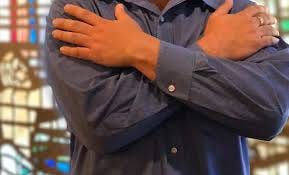
Some time ago in my own denomination, baptized children were prohibited to participate because of a the requirement of be confirmed or of make a Public Profession of Faith before participating at the Table. But since then the requirement of confirmation was removed, and we do not presently invite unbaptized people to come forward for blessing. Still it could be argued that this practice could still feel exclusionary by being a public sign of not belonging at the table.
What’s the Problem of Open Communion?
As much as I understand the motivation to create a spirit of welcome at the Lord’s Supper, I have some problems with this movement to greater openness. It seems to me that open communion might tend to lessen the meaning and impact of both the sacrament of baptism and Holy Communion. The fact is that in many churches, even those that are Reformed, do not fully grasp the depth of meaning in the Eucharist
The Reformed tradition has always taught that the sacraments actually accomplish what they signify. In baptism we are assured of being received into the Body of Christ, and in receiving Holy Communion we are assured of truly receiving Christ— just look at the vivid language expaining the sacraments in our historic confessions like the Heidelberg Catechism and the Belgic Confession.
But this traditional understanding that sacraments deliver what they signify has declined over the years, and I think that’s one reason for the renewed pressure to remove the restriction of baptism for participation at the Table. If these sacraments are merely symbols, then why not open communion to everyone? The danger is that both baptism and Holy Communion will be degraded through the good instinct to toward openness and inclusion.
Baptism has always been understood as the sacramental entrance into the church, the body of Christ. If that is forgotten or softened, then the sacrament of baptism is emptied of its meaning and the church has no real boundary. Some may think that’s a good thing, but I cannot shake my concerns as to what may be lost in the process. Any real community or institution needs to have some sense of boundary.
The same concerns apply to the Eucharist. Already, in many Reformed and other Protestant churches, Holy Communion is sidelined by being celebrated once a month or even less. This alone implies that it has less meaning and importance than the sermon or other liturgical elements we would not do without.
St. Paul has that stunning phrase in I Corinthians 11:29 about communion, “For all who eat and drink without discerning the Body, eat and drink judgement to themselves.” Now, he was saying this regarding a time when the sacrament was a whole meal, and some were evidently eating and drinking to the point of gluttony and drunkenness, making the whole thing a travesty. Still, these words at least imply that in the Lord’s Supper we are communing with Christ, and thus that Christians should understand (according to their capacity) what is actually happening for meaningful participation. I
It’s also striking to realize the extent to which the sacrament was guarded in the early church. The “Catechumens,” those who had been evangelized and were preparing for membership in the church, were not even allowed to witness the event. They were dismissed altogether when the service turned toward Holy Communion.
So Let’s Talk
So these are my concerns about this issue, and I lay them out not because I am firmly on the side of maintaining the restriction of participating in Communion to those who are baptized, but because I still have some important hesitation. So, it would be helpful to me and perhaps to other readers if we could have some open discussion about this issue. Your comments are welcome.
I like what John Van Oene said. God offers an open grace to all. We don’t withhold “preaching the word to all.” Why would we withhold communion? Just as with the encounter between Philip and the Ethiopian eunuch, what’s to keep me from baptism - nothing, so we could wonder, what’s to keep me from Christ’s body and blood. I’m inclined to say “nothing.” However, I have regularly said to all who participate, including baptized believers, “Now you’re on the hook, for you have taken part of Christ and you are called to live in response to that reality.”
My sense is that open communion reflects the all encompassing nature of God’s grace more fully than “close” or certainly closed communion. I particularly like the Ionia invitation to the table in all it’s variations:
"This is the table, not of the church, but of Jesus Christ. It is made ready for those who love him, and for those who want to love him more. So come, whether you have much faith or little; have tried to follow, or are afraid you've failed. Come, because it is His will that those who want to meet him, might meet him here."